
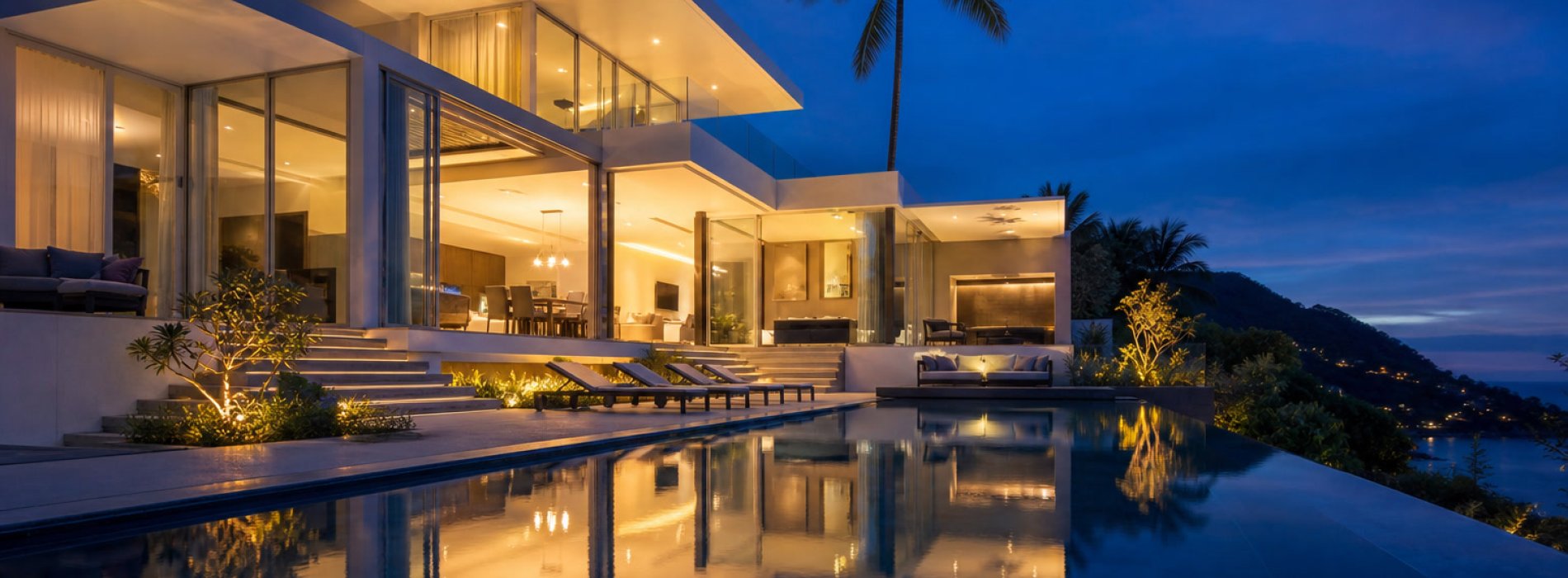
Quick answer: The best Phuket vacation rental investments are branded 1 to 2-bedroom condos in Bang Tao, Patong or Surin at USD 150,000 to USD 350,000, or compact pool villas in Bang Tao and Rawai at USD 250,000 to USD 600,000. Projected gross yields run 7 to 12 percent. Always confirm hotel-licence status before purchase under the 2004 Hotel Act.
Related guides: Freehold vs Leasehold in Phuket, How to buy property in Thailand as a foreigner, Elite Visa and property investment, Villas for sale in Bang Tao Phuket.
Profile of the Phuket Vacation Rental Investor
The typical Phuket vacation rental investor is aged 35 to 60, with investable capital of USD 150,000 to USD 1,500,000, an existing real estate portfolio (often 2 to 5 properties already in Europe, the Middle East, or East Asia), and a clear dual-purpose intent: use the property 4 to 8 weeks per year for personal stays, rent it the rest of the time for yield. Origin is heavily weighted toward Russia, Northern Europe, Hong Kong, Singapore, Australia and the Middle East. Annual income is comfortably in the USD 250,000 to USD 1,500,000 range, but for this segment cash-on-cash yield matters more than absolute price.
Decision drivers are explicit and quantitative. Projected gross and net yield, occupancy curves (high and low season splits), management fee structure, the hotel-licence status of the building under the 2004 Hotel Act, brand strength (a Sansiri, Banyan Tree or Laguna-branded condo commands a 15 to 25 percent rate premium versus a non-branded competitor), capital growth potential over a 5 to 10-year horizon, and ease of exit. Personal-use weeks are scheduled around school holidays in the buyer's home country, so units that block out 4 to 8 weeks remain viable when professionally calendarised.
Top Districts for Vacation Rental Yield
Patong remains the highest-occupancy district on the island. Year-round nightlife, beach, restaurants, and walkable amenities push high-season occupancy to 75 to 90 percent and low-season to 50 to 65 percent. Branded condos like The Marin, Patong Bay Hill and Sea Heaven dominate the investor pipeline. Pros: occupancy, ADR (average daily rate), liquidity. Cons: noise, monsoon-month dip, oversupply risk in some sub-zones.
Karon is the steady mid-season pick: a longer beach, lower density than Patong, and a family demand profile that smooths year-round occupancy. Pros: steady yield, balance of family and couple guests, capital growth runway. Cons: lower ADR than Patong or Surin.
Bang Tao and Laguna attract premium guests with longer stays. The Laguna Phuket master-development provides hotel-grade infrastructure across Cassia, Allamanda, Angsana and Banyan Tree Residences. ADR is 30 to 60 percent above Patong, and average stay length is 7 to 14 nights rather than 3 to 5. Pros: premium guests, brand premium, long stays. Cons: higher entry price, more seasonal swing.
Surin is the luxury vacation pick. Anantara Layan, Twinpalms Residences and Trisara Estate define this micro-market. Average villa ADR is USD 1,500 to USD 8,000 per night in high season. Pros: highest absolute revenue per asset, luxury guest profile. Cons: high acquisition cost, deeper seasonality, requires top-tier management.
Kata offers the strongest family-demand yield. Long beach, surf school, Kata Noi headland, and a stable returning-guest base. Pros: family demand, repeat guests, steady occupancy. Cons: less brand inventory than Bang Tao.
Recommended Property Types and Budgets
Investor preference clusters into 3 product types.
Branded apartments USD 150,000 to USD 350,000: 1 to 2-bedroom freehold condos in developer-managed buildings with an active hotel licence. Examples: Cassia, Allamanda, Diamond Condominium, The Marin, Patong Bay Hill, Sansiri Royce. These are the cleanest investment vehicle for foreign buyers because freehold ownership is straightforward and management is in-house.
Condotels USD 200,000 to USD 500,000: 1 to 2-bedroom units inside a hotel-operated tower (MGallery, Wyndham, Hyatt Place, Best Western). Often sold with a guaranteed-rental-return programme of 5 to 7 percent net for the first 3 to 7 years.
Pool villas USD 250,000 to USD 1,500,000: 2 to 4-bedroom villas in branded or semi-branded estates (MONO, Ananda, Anchan, Botanica, Trichada). Operated through specialist villa management firms. Higher gross yield potential (9 to 12 percent) but higher operational complexity and stricter hotel-licence considerations.
Key Considerations: Management, Hotel Licence, Yield, Exit
Management. Full-service vacation rental management charges 15 to 25 percent of gross revenue. Inclusions typically cover OTA listing management (Airbnb, Booking.com, Agoda, direct), dynamic pricing, guest communications, check-in and check-out, cleaning coordination, maintenance triage, monthly owner reporting, and tax filing support. Leading operators include Inspire, Magnolia Quality Development, Elite Havens (premium villas), and developer in-house teams for Laguna and Sansiri assets.
Hotel licence. Under the Thai Hotel Act of 2004, any rental shorter than 30 days requires a hotel licence. Most branded condo developments hold a development-level licence and pass operating authority to unit owners through the management agreement. Standalone villas and non-licensed condos can legally do monthly rentals only, unless the owner applies for their own hotel licence (a 6 to 18-month process). Enforcement has tightened since 2023, and OTA listings without verified licence status are at growing risk of takedown.
Yield. Realistic gross yields by zone (after typical 70 percent annual occupancy): Patong 7 to 9 percent, Karon 6 to 8 percent, Bang Tao 7 to 10 percent, Surin 6 to 9 percent (higher ADR offsets fewer rental nights), Rawai pool villas 8 to 12 percent. Net yield after management fees and operating costs typically 5 to 8 percent.
Exit and capital growth. The Phuket condo market has compounded at roughly 4 to 7 percent per year over the past decade, with branded developments outperforming. Liquidity for resale is highest in Patong and Bang Tao. For ownership-structure detail, see our freehold vs leasehold guide and the foreign buyer guide.
Sample Listings for Vacation Rental Investors
Five properties selected for their dual-purpose investment potential, located in the highest-occupancy vacation rental zones with projected gross yields of 7 to 12 percent under professional management.
- Cassia Residences, Bang Tao - 1-bedroom apartment from THB 5.4M (about USD 150,000). Branded by Banyan Tree, hotel-style daily rent licence in place, projected gross yield 8 to 10 percent.
- Allamanda Laguna, Bang Tao - 1-bedroom apartment from THB 7M (about USD 194,000). Lagoon view, on-site golf, mature Laguna brand, projected gross yield 7 to 9 percent.
- Diamond Condominium, Bang Tao - 2-bedroom apartment from THB 7.8M (about USD 216,000). Quiet residential, popular with returning long-stay guests, projected yield 8 percent.
- MONO Loft Villas, Bang Tao - 2-bedroom pool villa from THB 8.9M (about USD 247,000). High Airbnb conversion as a small pool villa, projected gross yield 9 to 12 percent.
- Ananda Villas, Bang Tao - 3-bedroom pool villa from THB 9.85M (about USD 274,000). Walking distance to Bang Tao Beach, family-sized villa with strong vacation rental demand year-round.
How to Get Started
The right path for an investor is a 4-step approach.
- Define your target yield and personal-use envelope: how many weeks per year you actually plan to stay, what gross/net yield you need to hit, what capital growth horizon. This drives the district and product type.
- Request our 12-month yield model for 5 to 8 shortlisted properties. We provide ADR, occupancy curves, management fee scenarios, and net yield across 2 management providers.
- Schedule a 2-day viewing trip covering 4 to 6 properties across 2 districts, plus meetings with 2 management operators.
- Engage a Thai property lawyer to confirm hotel-licence status, foreign-quota availability for condos, escrow, and transfer. Sign the management agreement within 30 days of completion to start the rental cycle immediately.
Frequently Asked Questions
What gross rental yield can I expect from a Phuket investment property?
Branded condos under hotel-style management typically deliver gross yields of 7 to 9 percent in Bang Tao, Patong and Karon, and 8 to 12 percent for compact pool villas in Bang Tao or Rawai. After management fees (15 to 25 percent) and operating costs, net yields land at 5 to 8 percent. Yield depends heavily on occupancy management and seasonality.
Do I need a hotel licence for short-term rentals in Phuket?
Yes. Under the Thai Hotel Act of 2004, any rental shorter than 30 days requires a hotel licence. Most branded condo developments (Cassia, Sansiri, Banyan Tree, MGallery) hold a development-level hotel licence allowing units to operate legally as daily rentals. Standalone villas and non-licensed condos can legally do monthly rentals only, unless the owner applies for their own licence.
Which Phuket district has the highest vacation rental occupancy?
Patong holds the highest year-round occupancy (75 to 90 percent in high season, 50 to 65 percent low season) thanks to nightlife and tourism volume. Bang Tao and Surin attract premium guests with longer stays and higher daily rates. Karon and Kata serve the family demand. Phuket Town has lower occupancy but stronger monthly-rental yield from nomads and expats.
What does property management cost in Phuket?
Full-service vacation rental management typically charges 15 to 25 percent of gross revenue for hotel-style operations (cleaning, guest comms, OTA listings, dynamic pricing, maintenance). Long-term residential management runs 8 to 12 percent. Larger villa operators (Inspire, Magnolia, Elite Havens) sit at the higher end with full hotel-grade service.
Can a foreigner own a vacation rental investment in Phuket?
Yes. Condos can be owned freehold within the 49 percent foreign quota, which makes branded apartments the cleanest investment vehicle. Pool villas require leasehold or Thai company structure on the land, with freehold building ownership. We strongly recommend reviewing our freehold vs leasehold guide before any investment purchase.